
My Backstory
First, to explain why I wrote this, it can be helpful for you to understand a bit of my background. I grew up in a neighborhood in Kansas City where many of my friends were doing drugs and having sex in elementary school, which lead too many to addiction or prison in high school.
After hitting my first rock bottom in high school, my drug of choice became workaholism. That took me to grad school at MIT where I co-founded the Internet and Telecoms Consortium with one of the father’s of the Internet, David Clark and starting my own dot.com during the dot.com boom.
I had set all these insanely ambitious goals for myself and achieved them. Once I got to the top of the ladder I realized it was leaning against the wrong wall. After hitting burnout from 6 years of working 100 hour workweeks of studying, research and activities, I said a prayer, “God either kill me or help me because I can’t keep living like this.”
While no angel showed up, God responded with a series of miraculous encounters that defied all reasonable probability. I pivoted my whole life and started an organization to use my tech powers for good.
If you listen to The Founder, there is more than a little of my own story in the two protagonists: Eli and Scarlett. Eli and Scarlett represent different parts of myself imagined 1,000 fold better to almost superhero levels. So while I don’t claim their uncanny level of gifting, I do claim many of their core flaws translated into a different context.
My Nerdiness
Secondly, I wrote this because fundamentally I’m a nerd at heart. I’ve read, watched and listened to an insane amount of science fiction and fantasy. At MIT, I received a Master’s Degree in Computer Science (Course 6) and Technology and Policy (which is a part of MIT’s Institute for Data, Systems, and Society). I was so burnt out at MIT, I swore I would never get a doctorate and left after my Master’s despite having one of the best full-ride scholarships available for the doctoral program.
Along the way, I became the president of City Vision University, and our accreditor said I needed to get a doctorate. So I completed an interdisciplinary doctorate at Bakke University merging the fields of Theology, Systems Dynamics, Education and Entrepreneurship to develop a strategy to reinvent the model of higher education to fit the current world.
In addition to being a voracious reader of science fiction and fantasy, I also have an insatiable hunger for learning. I jokingly say that my goal has been to do self-study on an additional (non-accredited) Master’s degree every year or two: history, cross-cultural studies, theoretical physics, theology, church history, business, nonprofit management, counseling, most social sciences, media ecology and more. I’m just grateful that I switch mostly to audiobooks and digital books about 15 years ago because I would have run out of space in my home for books. As it stands, there are still way to many books covering way too many topics taking up a large amount of real estate in my home. I never really had a plan for where all this knowledge would go, but I just enjoyed learning.
My Pragmatism, the Systems Thinking Lens and Storytelling
City Vision University initially grew out of a group of Christian homeless shelters and addiction recovery programs called the Citygate Network. More than 80% of our students come from partner organizations like this as well as groups like the Salvation Army. While about two-thirds of our students are leaders in these organization, about one-third are in our Wounded Healers Program graduates of their intensive one year recovery programs helping them to stabilize after being homeless, addicted and/or imprisoned.
So why would the president of a niche online university serving the Christian social services sector write a book this nerdy? A lot of it, is that what is in this book is a part of who I am that needed to get out. Let me say clearly that this book is a personal project, so that anything I say that is theologically off-base or is offensive, is from my own personal ignorance and fallen nature.
In 2025, I was working on designing an interdisciplinary doctoral program. The primary goal of the program is to help change the trajectories of organizations and movements that are transforming the lives of millions of the most destitute people on the planet. As is a natural in everything, these organizations and movements have a natural tendency to atrophy and become less effective over time. The goal of this interdisciplinary program is to help them create a new wineskin (systems and paradigms) for new wine (today’s context) to help solve society’s great problems.
In many ways it represented a synthesis of everything I’ve learned to date. To design the doctoral program, I had to essentially deconstruct and reconstruct the entire philosophical foundations of higher education and research. I realize that Einstein’s quote “We can’t solve problems by using the same kind of thinking we used when we created them” means that we need new lenses (or toolkit or paradigm) to solve today’s problems.
One of the courses I designed in our doctoral program was ORG710: System Thinking, Worldviews and Social Change. After designing that course, I realized that more than any other lens, the Systems lens (with a spiritual perspective) is what’s missing to diagnose and address the world’s problems.
Then I realized that our doctoral students even with their influence in movements that might affect millions of people, were still only a drop of water in the ocean of need. To really have a broader impact on culture, the synthesis of ideas that I was developing would need a different format than a doctoral program.
I thought about C.S. Lewis, and while his nonfiction apologetics have had some impact, his greatest impact was through storytelling. His masterful storytelling in the Chronicles of Narnia created mythology or parable that helped bridge Christian concepts into future generations well beyond his nonfiction.
I realized that to really have an impact, I would need to help spread these ideas through storytelling. That was when I started to get the vision for The Founder: A Cyberpunk Parable. I realized that the Cyberpunk genre (reimagined as Scarlett describes it in the Cyberpunk Pentecost) was the perfect genre to create help spread the lens of a contextualized theology of systems to the broader public.
Why Am I Using AI and Does that Make this AI Slop?
As I stated above, I’m a nerd. I also am an idea person and a big picture person. How this translates, it that my strengths as a writer are on the big picture world building arch’s of writing and developing depth to the ideas in that world. Part of the strength of world of The Founder Parable is that it is super nerdy.
What you are not seeing is that the “source code” or the underlying “book” document that I’m using to generate the NotebookLM audio overview narrations is at least 10 times nerdier. As an example of this, you can read Source Code Excerpt of Beginning of Episode 5. His Story: The Cyberpunk Gospel.
If you read that and fully understood all the calculus, congratulations, you should probably qualify for a PhD in Physics from MIT! For the rest of you, I’m actually doing you a favor by translating the “source code” into something more coherent that (hopefully) won’t put you to sleep while driving. The material is already super dense and heady, but I don’t think that most people listening to an audio story really want to be taking a doctoral course.
While NotebookLM would likely be terrible for most fictional serial fiction audio podcasts, I personally believe it actually kind of fits this genre. The Founder Parable is a story integrating deep technical ideas. While part of the Chronicles of Narnia appeal was that because it was written targeting children, it was accessible to everyone. I suspect that few children (except maybe those who are on the spectrum and or are nerdy like I was) will have the patience for a story like this.
A second reason why I’m using AI in this project is that I’m writing this as a Minimum Viable Product (MVP) as a proof of concept of an epic story. The concept of an MVP comes out of Lean Startup methodology for start-ups. The idea is that when developing a new project in a highly unknown space, what determines the quality of the end product more than anything is how quickly you are able to iterate between versions to improve the product.
Before ever publishing this serial science fiction podcast, I have literally already gone through hundreds of iterations on the book and its episodes. This process of having highly a flexible “source code” document that is then “compiled” into a podcast using NotebookLM audio overviews has been a game changer in the creative process for a big picture person like me.
Disclaimer for the Legalists Promoting Cancel Culture
A friend of mine who founded an amazing city-transforming ministry, told me that he waited 40 years to publish his book because he was afraid that if he said something wrong, his ministry career would be over. One one hand, I get it. Cancel culture’s existed in Christianity since the days of the Pharisees, only now the weapons of mass destruction of cancel culture are distributed to everyone.
There are very good reasons for avoiding heresies. He mentioned how certain very specific phrases that if you use in the wrong way, were declared heresy over a thousand years ago. You might have accidentally hit a heresy land mine without ever knowing it. The last thing I would want to do is to let my big picture mind say something the wrong way in translating some of these concepts into the Cyberpunk genera and stumble into a heresy.
However, on another level, I think things are different in the digital age. My friend was coming from a background where for most of his life typewriters didn’t have a backspace button, and once you printed a book edition, it was fixed essentially into stone (or at least print). If you did say something in a way that was theologically across the line there would be widely distributed evidence to the whole world of your apostacy.
Proposed Model of Humility and Grace
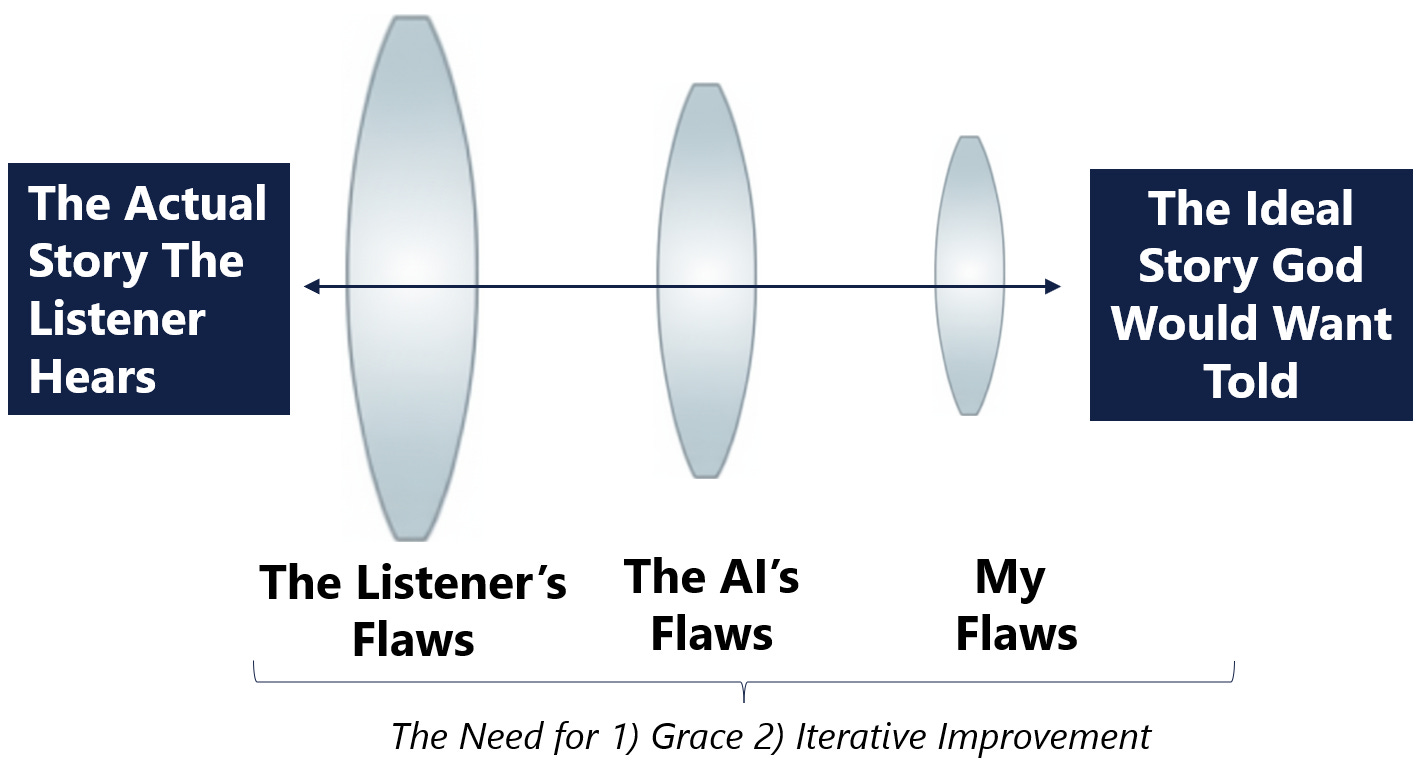
Paul said in 1 Corinthians 13:12 that we all “See through a glass, darkly” (listen to a more in depth discussion on this in Episode 7). Based on this, I would like to propose a model for humility and grace in this project as shown above. We start with the ideal story God would want told for His purposes. That unfortunately goes through the dark glass of my own flaws. Then if I’m using AI for a component, it goes through the AI’s flaws. Then finally it goes through the listener’s flaws.
Given all this, my hope is that by doing this in an environment of grace and iterative improvement, we can together improve the story to decrease the distortions introduced by all of our lenses.
One example of this is that in an earlier version of the story, the protagonist’s name was Eli’s Stone. The AI generating NotebookLM audio overviews in its love for creating pithy sayings connecting different ideas, kept inserting into the story applying to Eli, “The stone that the builders rejected, has become the cornerstone.” Now, while on one hand that masterfully fit his origin story and tied it to a Biblical phrase, it also put Eli in the position of Jesus, which is not something we want to do.
Now I know enough to catch that one, but I’m still worried that I or the AI might use some language or place an emphasis that unknowingly was declared a heresy in the 5 century. The best strategy isn’t to be perfect and wait 40 years to get this out there. The best strategy is to have grace and quickly iterate.
Why this is A Cyberpunk Parable and Not A Cyberpunk Gospel
Sanctified Imagination and Worship Wars
I wrote this as a parable because of the proposed model/diagram above of humility. This is not a Cyberpunk Gospel, which would be claiming that my lens is perfect.
Along those lines, my goal is this series is to stay within the bounds of “sanctified imagination” that series like The Chosen have followed. I recognize that Evangelicals are inherently cautious about eisegesis (reading one’s own ideas into the text) or violating Revelation 22:18 (adding to God’s words). A sanctified imagination uses deep historical, cultural, and socio-political research to construct plausible scenarios that could have happened between the verses, without contradicting the explicit text. What I’m really trying to do is provide cultural contextualization in a way similar to The Chosen but for other people groups that often do not relate to traditional approaches to communicating the Gospel.
This story is an artistic artifact, not Special Revelation. It is not inspired, nor is it inerrant. This story is in the category of historical fiction based on true events. The goal is that it would be like a C.S. Lewis novel—helpful and illuminating, but subordinate to the biblical text.
If I did contradict the explicit text or traditional core church doctrine (like the Apostle’s Creed), that is either from my own flaw or that of the AI or both. When I become aware of that, my intent is to correct it as quickly as possible. Having said that there is no way that I can write this and align with all denominational doctrine because they differ.
What I’m really trying to do is provide cultural contextualization in a way similar to The Chosen but for other people groups that often do not relate to traditional approaches to communicating the Gospel. My hope is that this story can serve as narrative apologetics or Praeparatio Evangelica (preparation for the Gospel)
Where I Dream This Might Go?
The Dream 1: Book, Manga, Webtoon, Anima or TV
My real (possibly too ambitious) hope is that this proof of concept might build up enough momentum that it could be made into a Manga or Webtoon graphic story, an anime or (in my wildest dreams) even a TV series. My guess is that if that ever does happen, it most likely would be posthumously like it is for so many authors. If someday, I have time, I may try to turn it into an actual book, but the challenge with that is I have a day job I love where I’m a part of a team transforming hundreds of lives.
The Dream 2: User Generated Content Communities
I also dream that if this gets momentum, we could generate some user generated content communities. As a techie, I believe AI has the potential to change fan fiction on a scale never seen before. I’ve designed this story with some of the following user generated content communities and become collaborative culture makers of this universe:
Stories of The 144k Wounded Healers AI Assisted Fan Fiction: I wrote the story of The 144k Wounded Healers (and especially Episode 12. Training of the 144k Wounded Healers) with the vision in mind that this could be a container for an AI generated fan fiction site. The Founder: A Cyberpunk Parable is centered around what I can write about, which in the terms of the story is connected to the cultural clusters God has made me a router for. Part of the intent of this section is that fans could generate their own stories written centered around who God has made them to be as routers to different cultural clusters to adapt stories to every tongue, tribe and nation.
The Cyberpunk Psalms AI Assisted Fan-Fiction Song Creation: This would mirror the above section, but my hope is that fans could use AI to create their own Cyberpunk Psalms. If the stories are written to the head, the Cyberpunk Psalms are written to the heart. My hope is that fans could use AI to write their own Cyberpunk Psalms in every genre for every tongue, tribe and nation.
Adaptations of The Founder with AI Assisted Art, Manga and Webtunes. I created some basic art for the podcast to help get things started, but I expect that others could do much better with their own AI assisted art. In addition, ultimately, I think if the story of The Founder ever gets becomes a show, it is most likely start as Manga or Korean Webtunes that eventually get adapted to anime.
Adaptations of The Founder with AI Assisted Video Creation. If AI assisted video creation continues to advance the way it has, the user community may be able to develop our own scenes or even full episodes.
This vision doesn’t mean there would be a free for all, which could quickly descent into syncretism. My thought in all of this is that there would likely be a three tier system
User generated content that becomes “cannon” and is integrated into the core story.
User generated content that is a part of official user generated content communities.
User generated content that is a lies of official user generated content communities. In many cases, this might be content that falls in the the syncretism category.
Again, this is all a dream that is based on the idea that The Founder gets a critical mass of momentum.
Real Cultural Change to Bring Societal Transformation
My goal in all this is not to get any accolades. The part of the Scarlett’s story (in Episode 3 and throughout) where she is very self aware of the danger of fame is close to home for me. My real hope is to help transform the popular culture. For non-Christians, I want to provide paradigms to reduce needless intellectual barriers to embracing Christianity (that might be culturally analogous to early Jewish Christians demanding that Gentile Christians follow the Mosaic law and become culturally Jewish). Similarly, there is an extra-Biblical Christian culture that we have been needlessly requiring that non-Christians accept. I believe that is a big part of the reason for the rise of the “nones” who refuse to affiliate with Christianity.
For Christians, my hope is that this book could help introduce systems paradigms that could enable us to more effectively engage with the broader culture to help be a major part of the solution to society’s great problems. We need to move beyond the simplistic understanding of truth being a debate between a rigid black and white modernist understanding of truth vs. postmodernism and relativism. The systems perspective helps to give us much more nuanced tools to help explain that there can still be truth even though as flawed humans, we can never have a complete understanding of truth.
Subscribe to get full access to the newsletter and publication archives.